Choosing the Right Plants for Warren County
Selecting trees and shrubs for your Southwest Ohio property is about far more than aesthetics. The right species will thrive in our USDA Hardiness Zone 6a climate, tolerate our clay-heavy soils, withstand Ohio’s temperature swings, and provide decades of beauty and function with reasonable maintenance.
The wrong choices lead to constant problems: trees that split in ice storms, shrubs that struggle in our clay, and ornamentals that succumb to pests and diseases common to the region.
After nearly four decades of landscaping in Lebanon, Springboro, Mason, and across Warren County, we have seen what works and what does not. Here are our top recommendations for trees and shrubs that perform reliably in Southwest Ohio.
Best Shade Trees for Warren County Properties
Red Maple (Acer rubrum)
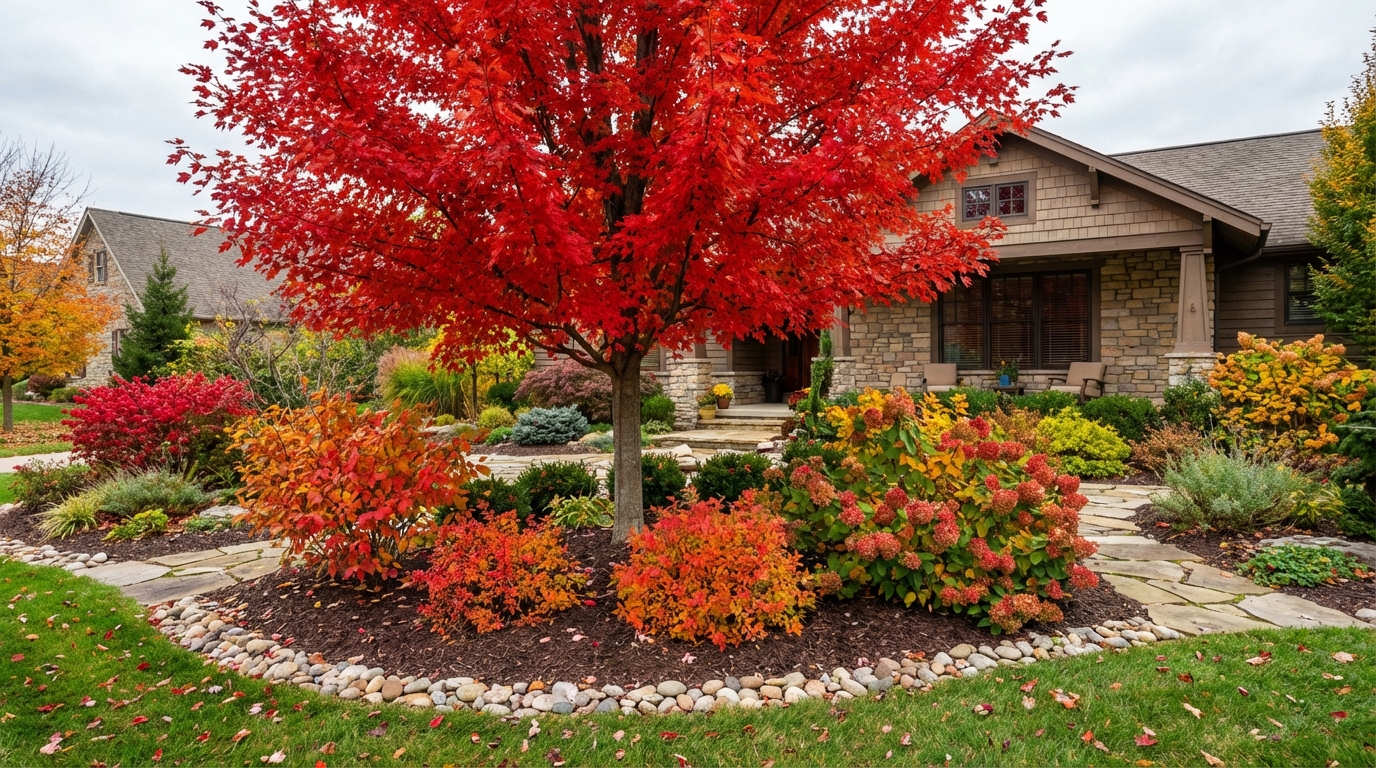
The red maple is one of the most versatile native trees for Southwest Ohio. It tolerates wet clay soils better than most maples, provides excellent fall color ranging from orange to deep red, and grows at a moderate pace.
- Mature height: 40-60 feet
- Growth rate: Moderate (1-2 feet per year)
- Best for: Front yards, side yards, and anywhere you need reliable shade
- Warren County advantage: Native to Ohio and naturally adapted to our soil and climate conditions
Bald Cypress (Taxodium distichum)
Despite its association with southern swamps, bald cypress is surprisingly hardy in Zone 6 and thrives in Warren County’s wet clay soils where other trees struggle. Its feathery foliage turns a warm copper in autumn.
- Mature height: 50-70 feet
- Growth rate: Moderate (1-2 feet per year)
- Best for: Wet areas, low spots, and properties with drainage challenges
- Warren County advantage: Handles our clay soils and periodic wet conditions that kill many other species
American Hornbeam (Carpinus caroliniana)
An underused native tree that deserves more attention from Warren County homeowners. It tolerates shade, handles our soils well, and provides striking muscle-like bark and reliable orange-red fall color.
- Mature height: 20-35 feet
- Growth rate: Slow to moderate
- Best for: Under larger trees, small yards, patio areas, and naturalized plantings
- Warren County advantage: Native understory tree that thrives in the partial shade common under Ohio’s mature tree canopy
Northern Red Oak (Quercus rubra)
A stately native that grows faster than most oaks and provides outstanding fall color. Red oaks adapt well to Warren County’s clay soils and develop into magnificent specimens over time.
- Mature height: 60-75 feet
- Growth rate: Moderate to fast (2 feet per year)
- Best for: Large properties where you want a long-lived shade tree with presence
- Warren County advantage: Native to Ohio, tolerant of our soils, and resistant to most local pests
Best Ornamental Trees
Eastern Redbud (Cercis canadensis)
The redbud is a Warren County favorite for good reason. Its purple-pink spring blooms appear before the leaves, creating one of the first splashes of color in the Ohio landscape each year.
- Mature height: 20-30 feet
- Growth rate: Moderate
- Best for: Foundation plantings, garden focal points, and mixed borders
- Local tip: Redbuds grow naturally in the wooded areas along the Little Miami River and throughout Warren County’s parks. You will see them blooming along the bike trail each April.
Serviceberry (Amelanchier)
A multi-season performer that offers white spring flowers, edible berries in early summer, excellent fall color, and attractive bark in winter. Available in both tree and multi-stem forms.
- Mature height: 15-25 feet (depending on variety)
- Growth rate: Moderate
- Best for: Foundation plantings, mixed borders, and small yard centerpieces
- Warren County advantage: Native, drought-tolerant once established, and attractive to songbirds
Kousa Dogwood (Cornus kousa)
While our native flowering dogwood (Cornus florida) has been devastated by dogwood anthracnose in many parts of Ohio, the Asian Kousa dogwood is resistant to this disease and performs beautifully in Warren County.
- Mature height: 15-30 feet
- Growth rate: Slow to moderate
- Best for: Specimen plantings, garden focal points, and foundation areas
- Important note: Blooms later than native dogwoods (June vs. April), providing a second wave of white or pink spring flowers
Best Shrubs for Southwest Ohio
Oakleaf Hydrangea (Hydrangea quercifolia)
One of the best multi-season shrubs available for Warren County. Large white flower clusters in summer turn pink in fall, while the oak-shaped leaves provide outstanding autumn color and the exfoliating bark adds winter interest.
- Mature height: 4-8 feet
- Light requirements: Part shade to shade (ideal for north-facing foundations)
- Warren County advantage: Native to the southeastern U.S. but extremely hardy in Zone 6, and one of the few hydrangeas that performs reliably in our clay soils without constant amendment
Winterberry Holly (Ilex verticillata)
A native deciduous holly that produces brilliant red berries on bare winter branches. Few shrubs provide more visual impact in the winter landscape.
- Mature height: 6-10 feet
- Light requirements: Full sun to part shade
- Important: You need at least one male pollinator plant for every 5-6 female berry-producing plants
- Warren County advantage: Thrives in wet clay soils that defeat most other ornamentals
Virginia Sweetspire (Itea virginica)
An adaptable native shrub with fragrant white flower spikes in early summer and deep red to purple fall color that persists well into winter.
- Mature height: 3-6 feet
- Light requirements: Full sun to full shade
- Best for: Foundation plantings, rain gardens, and mass plantings on slopes
- Warren County advantage: Handles wet feet and clay soils, making it ideal for the drainage-challenged areas common in many Lebanon and Springboro yards
Ninebark (Physocarpus opulifolius)
A tough native shrub available in purple-leaved varieties like ‘Diabolo’ and ‘Summer Wine’ that add dramatic color contrast to the landscape. Extremely low maintenance once established.
- Mature height: 5-8 feet
- Light requirements: Full sun for best foliage color
- Best for: Hedges, mixed borders, and anywhere you need a low-maintenance screen
- Warren County advantage: Nearly indestructible in our climate — tolerates drought, clay, and neglect
Trees and Shrubs to Avoid in Warren County
Not every popular nursery plant is a good choice for Southwest Ohio. Based on our experience, avoid or carefully consider:
- Silver Maple — Fast growing but weak-wooded, prone to storm damage, and aggressive surface roots that damage sidewalks and driveways
- Bradford Pear — Splits apart in ice and wind storms, is now classified as invasive in Ohio, and the wood produces a notoriously unpleasant odor
- Burning Bush (Euonymus alatus) — Classified as invasive in Ohio and being phased out of many nurseries. Native alternatives like Virginia sweetspire and fothergilla provide equal or better fall color
- Leyland Cypress — Marginally hardy in Zone 6 and frequently killed by severe Ohio winters. Use Green Giant arborvitae instead for an evergreen screen
Planting Tips for Warren County’s Clay Soil
Ohio’s clay soil is challenging for new plantings. Here are proven techniques we use on every installation:
- Dig wide, not deep. The planting hole should be 2-3 times wider than the root ball but no deeper. In clay soil, a deep hole fills with water and drowns the roots.
- Do not amend the backfill. Fill the hole with the same clay soil you dug out. If you fill the hole with potting mix, roots will circle inside the amended area and never grow into the surrounding soil.
- Mulch correctly. Apply 2-3 inches of hardwood mulch in a wide ring around the base, but keep it 4-6 inches away from the trunk. Volcano mulching (piling mulch against the trunk) causes bark rot and kills trees.
- Water deeply for the first two years. New trees and shrubs need supplemental watering during dry spells for at least two growing seasons until their roots establish in the surrounding clay.
Planning Your Landscape
Choosing the right trees and shrubs is an investment that pays dividends for decades. The species listed above have proven themselves across thousands of Warren County properties over the years.
Ready to plan your landscape? Contact Poff’s Lawn Care & Pest Control for a free consultation. We will assess your property’s conditions, recommend the best species for your goals, and handle the installation. Call (513) 932-1319 or request a consultation online.